Convergent genomic responses of human gut bacteria to variations in industrialization
Jan 1, 2025·,,,,,,,,,,,,,,,,,,,,,,,,,,,,·
0 min read
Malte Ruehlemann
Lénárd L. Szánthó
Silvio Waschina
Lucas Moitinho-Silva
Laura K. Mews
Joan F. Camarena
Hannah Jebens
John Costa
Vanessa Juimo
Alain Fezeu
Adwoa Agyei
Mary Y. Afihene
Shadrack O. Asibey
Yaw A. Awuku
Amoako Duah
Yvonne A. Nartey
Fatimah Ibrahim
Yvonne A. L. Lim
Tan M. Pin
Charles Onyekwere
John Rusine
Ivan E. Mwikarago
John Baines
Andre Franke
Gergely J Szöllősi
Ramnik Xavier
Eric J. Alm
Mathieu Groussin
Mathilde Poyet
Abstract
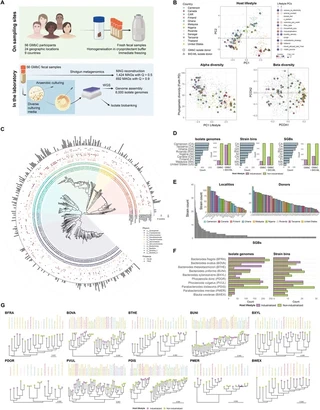
To what extent gut bacteria respond to the distinct ecological pressures imposed by human lifestyle remains unclear. Here, we investigate how genomic adaptation in gut bacteria differ between industrialized and non-industrialized human populations. We generated a broad collection of isolate genomes spanning diverse host geographies, lifestyles, species, and strains. We first found that compared to MAGs, paired isolate genomes recover more functional elements and signals of horizontal gene transfers (HGTs). Leveraging isolate genomes from multiple species, we find that strains from industrialized hosts experience an expansion of proteome size and harbor greater pangenome fluidity, driven by recent events of HGTs. Gene- and variant-level analyses reveal convergent patterns of lifestyle-specific adaptation in functions that are critical for ecological adaptation, such as stress response, cell envelope remodeling and central metabolism. Our results demonstrate that industrialization imprints evolutionary signatures on gut bacterial genomes, illuminating the effects of rapidly changing environments on human biology.Competing Interest StatementR.J.X. is a co-founder of Convergence Bio, board director at MoonLake Immunotherapeutics, a consultant to Nestle, and a member of the advisory boards at MagnetBiomedicine and Arena Bioworks. No organizations listed above provided funding for this study.Short read data and assemblies of GMbC isolate genomes generated in this study will be made available online on the dbGaP server (Study ID: 38715; Accession: phs002235.v1.p1; Accession: phs002205.v1.p1) upon publication of the article. GMbC metagenomes used in this study and published in our recent study 6 will be made available at the same dbGaP study.
Type
Publication
bioRxiv